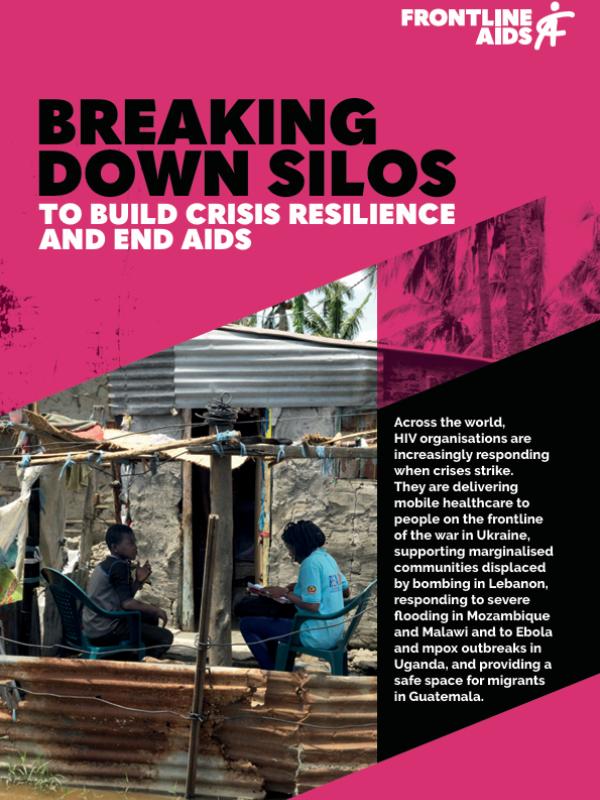
This insights brief explores how collaboration between HIV, humanitarian and crisis-response actors can improve resilience and help sustain progress towards ending AIDS. With examples from Ukraine, Lebanon, Mozambique, Uganda, or Guatemala, it highlights the role that community-led responses can play in strengthening resilience and ensuring continuity of essential services during humanitarian emergencies.
Continue reading
Practical guidance developed by the UNAIDS Regional Support Team for Latin America and the Caribbean to support continuity of the HIV response in the context of the August 2026 earthquake in Colombia.
Continue reading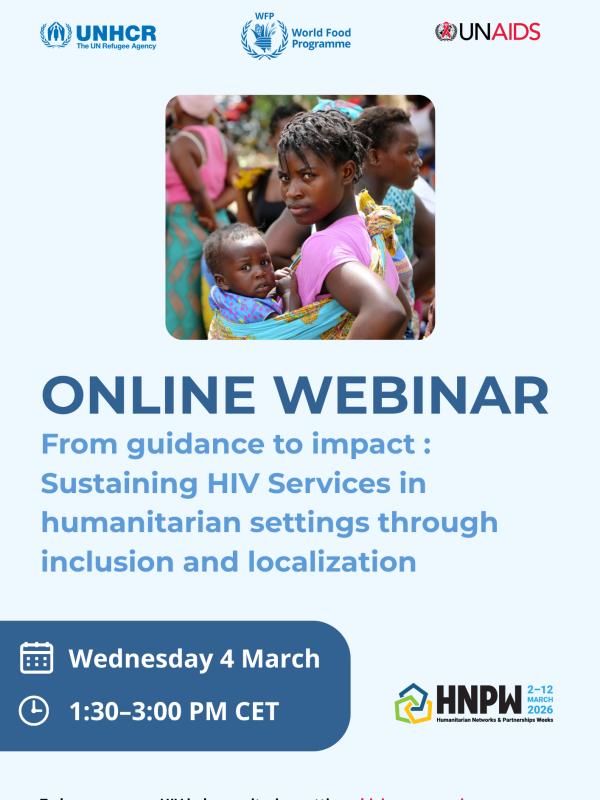
The webinar brought together humanitarian actors, technical experts, and community leaders to confront a stark reality: as humanitarian needs surge and funding declines, the space for essential HIV services is rapidly narrowing. The session explored the critical interface between HIV and humanitarian emergencies, introduced key updates on the revision of the IASC Guidelines for Addressing HIV in Humanitarian Settings, and featured a panel with speakers from MSF, FHI 360, 100% Life Ukraine and Young Positive South Sudan sharing concrete approaches for safeguarding, sustaining and expanding HIV services in the harshest conditions despite shrinking resources.
Continue reading
The global HIV response is at a pivotal moment: while we are closer than ever to ending AIDS as a public health threat, progress is increasingly at risk due to converging crises, volatility, and widening inequalities. The Strategy integrates HIV in humanitarian settings , calling for HIV to be embedded in security, disaster preparedness, and humanitarian response plans, and emphasizing the need to maintain HIV and SRHR services — including for survivors of SGBV — during emergencies. It also underscores the essential role of community‑led organizations, which often sustain access to services when formal systems are disrupted, facilitating uninterrupted access to treatment.
Continue reading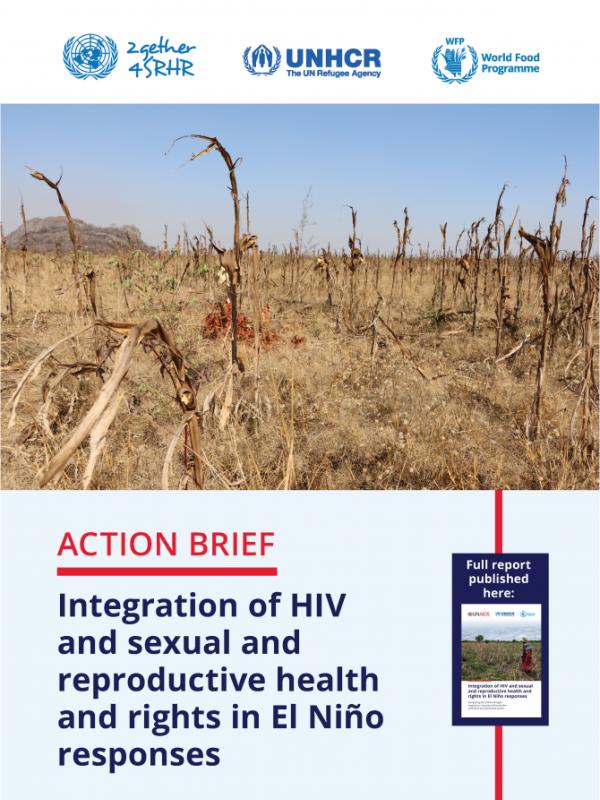
The action brief is summarizing key findings, lessons learnt and recommendations from the The El Niño comparative study, jointly commissioned by UNAIDS, WFP, and UNHCR to examine the impacts of the 2015/2016 and 2023/2024 El Niño events on HIV in Southern Africa within in the context of access to HIV-related services, sexual and reproductive health and rights (SRHR), genderbased violence (GBV), food insecurity, and displacement. The full report can be found in the library.
Continue reading